


🌙 Why Does Sleep Change During Pregnancy?
Sleep during pregnancy changes completely 🤰. Hormones are the main conductors 🎶: they increase sleepiness, but also trigger heartburn, snoring, and nighttime wakings. Add to that frequent bathroom trips 🚽, baby’s movements 🤸, and back pain… and nights turn into short episodes instead of one long movie 🎬. In a way, your body is already training for life with your baby 👶.
1 min read

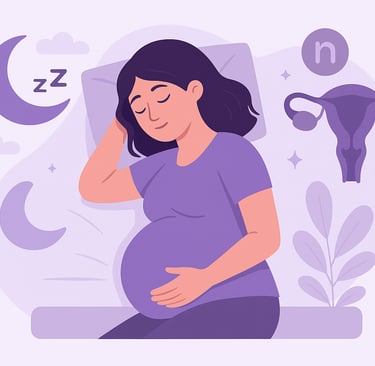
Today, let’s talk about something almost every mom-to-be experiences 🤰: sleep during pregnancy.
If your nights feel more like a series of short episodes than one full-length movie 🎬, rest assured—it’s normal, and it’s your body adapting.
🧪 Hormones: the conductors of your sleep
Pregnancy is like your body running a massive construction site 👷♀️. Hormones are the workers: they prepare your body for baby, but they also bring side effects that impact sleep.
Progesterone → think of it as a soft blanket 🛌 helping you drift off, especially in the first trimester. It makes you drowsy, which explains sudden naps and waves of fatigue.
👉 But… that same blanket can feel too heavy: it relaxes muscles, leading to heartburn or nighttime wakings.Estrogen → early on, it can improve sleep. But later in pregnancy, it’s like it “clogs the house vents” 🏠: nasal congestion, snoring, even sleep apnea in the third trimester.
Cortisol & prolactin → these hormones prep your body for breastfeeding and baby’s arrival 🍼. But they act like little alarms ⏰: fragmenting sleep and making nights less restorative.
🌛 Why so many night wakings?
Your sleep is like a cake 🎂 cut into many slices instead of one big piece. Several reasons:
A compressed bladder → frequent bathroom trips 🚽.
Baby’s nighttime gymnastics 🤸.
Back pain or leg cramps → caused by extra weight and relaxin (the hormone that loosens ligaments).
👉 The result: more wake-ups, and more daytime fatigue 😴.
⏰ A shifting biological rhythm
Your body clock (circadian rhythm) is also thrown off balance.
Melatonin (the sleep hormone) rises, helping regulate your sleep and baby’s 🍼.
You may feel sleepy earlier in the evening and crave naps ☀️.
But frequent wake-ups disrupt your rhythm → later bedtimes, earlier mornings.
It’s as if your body is already training for newborn life 👶—where nights are naturally fragmented.
Motherhood
Your space dedicated to motherhood and well-being.
CoNTACT
bellytobaby.fr@gmail.com
© 2025. All rights reserved.