


🌙 Why Does Sleep Become More Difficult During Pregnancy?
During pregnancy, the body goes through huge changes 🤰: a growing belly, shifting organs, and a baby that never stops moving—all of which make sleep harder. Between the search for a comfortable position 🛌, back pain, heartburn 🔥, endless bathroom trips 🚽, and baby’s nighttime gymnastics 🤸, nights are often fragmented. These discomforts are normal, but they explain why so many moms-to-be feel tired during the day 🌸.
1 min read
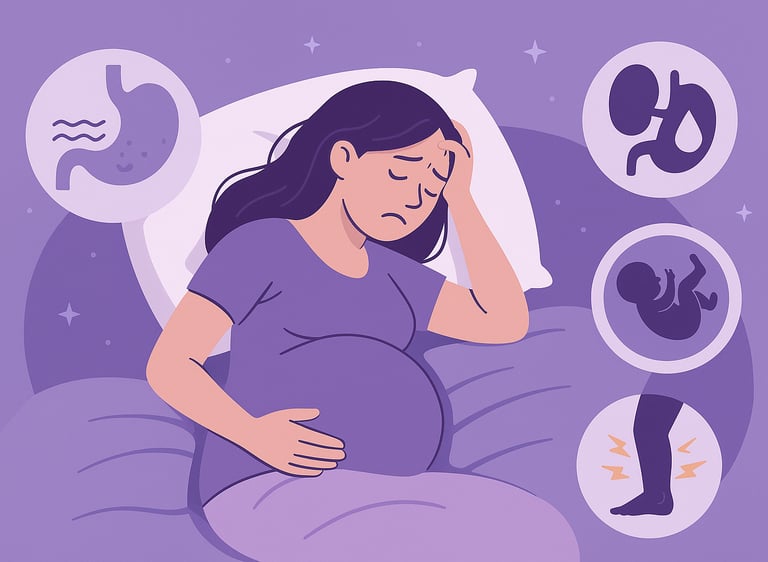
Beyond hormones, the body changes a lot during pregnancy 🤰. Your belly grows, organs shift, baby moves… These transformations are normal, but they often make nights more complicated and affect sleep quality.
🛌 Finding a good position: a real challenge
As the months go by, the bed becomes an experiment zone 😅:
On your stomach → quickly impossible with a growing belly.
On your back → not recommended in the third trimester, since the uterus presses on the vena cava (a major vein), which can cause dizziness and reduce blood flow to baby.
On your left side → the best position ❤️, because it improves circulation and reduces swelling. But staying too long on one side may cause hip or back pain.
👉 Lower back pain often comes from extra weight, posture changes, and relaxin (a hormone that loosens joints). Add nighttime cramps (calves, feet)… and you’ve got sudden wake-ups ⚡.
🔥 Heartburn and nighttime nausea
Many pregnant women deal with the dreaded evening “heartburn.”
Progesterone relaxes the esophagus.
The growing uterus presses on the stomach.
👉 The result: acid reflux, regurgitation, and discomfort that makes it hard to fall asleep.
And nausea—especially in the first trimester—doesn’t just strike in the morning. It can hit at night, forcing you out of bed. Luckily, it eases after the third month for most women.
🚽 Frequent trips to the bathroom
Getting up several times a night to pee? You’re not alone!
From the first trimester: the kidneys are already working harder.
In the second and third trimesters: the uterus presses on the bladder.
👉 These repeated bathroom trips cut into deep sleep phases—explaining why daytime fatigue feels even heavier.
👶 Baby’s nighttime gymnastics
From the second trimester on, baby starts their midnight workouts 🤸. Many moms-to-be notice the activity peaks when they’re lying down to rest.
Why?
During the day, your movements gently rock baby to sleep.
At night, when you’re still, baby has more freedom to move.
Hormonal shifts also boost fetal activity at night.
👉 Those kicks and wiggles are reassuring signs of vitality—but they can also wake you up or keep you from dozing off.
Motherhood
Your space dedicated to motherhood and well-being.
CoNTACT
bellytobaby.fr@gmail.com
© 2025. All rights reserved.