


👨👩👧 The Role of the Father / Co-Parent
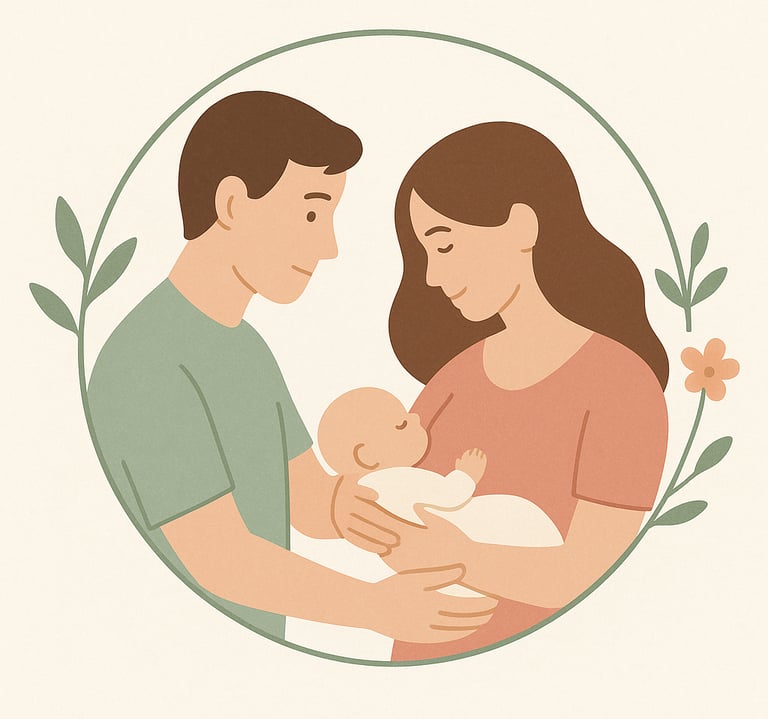
Motherhood is never just about the mother.
It also opens up reflection on the father, the co-parent, and every form of parenthood possible today 🌍.
🌱 A Presence in Search of Itself
While pregnancy places the mother at the biological center, the father or co-parent lives a different experience: close, yet on the periphery.
They don’t inhabit the transforming body 🤰, but they inhabit the waiting—the mystery of a life being woven without them, and yet, thanks to them.
Psychologically, this can create a paradox: the desire to feel essential ❤️, paired with the sense of not having a clear place.
Motherhood seems to say to fatherhood: “You are not within me, but you are beside me.”
🤲 From Spectator to Participant
At birth, the role shifts. The one who observed becomes guardian, supporter, witness to the very first breath 👶.
The father/co-parent often embodies grounding: the one who watches over, who protects, who holds emotions when they spill over 🌊.
Philosophically, this raises a deeper question of connection and responsibility: giving life is not limited to the biological act of conception, but to the decision to keep showing up, again and again ⏳.
To be a parent is less about “having” a child than about committing to them.
🌿 Shared Parenthood
In the postpartum period, the co-parent’s role becomes crucial. They can lighten the load, create breathing space for the mother 🌬️—or, by stepping away, deepen the weight she already carries.
Here lies a psychological truth: motherhood says something about fatherhood—it calls on its ability for tangible presence.
Changing a diaper 🍼, preparing a meal 🍲, listening in the silence of sleepless nights 🌙—simple gestures, yet profoundly meaningful. They say “I share.” They say “I’m here.”
🌸 A Plural Parenthood
Motherhood today also invites us to rethink parenthood in its broadest sense.
Father, mother, two mothers, two fathers, chosen co-parents, blended families—
what matters is not the form, but the quality of presence 💞.
Philosophy reminds us that parenthood is not only biological, but symbolic and relational: those who love, who raise, who accompany are fully parents, because they pass on a piece of life.
🌟 In the End
Motherhood says to fatherhood—or to any form of parenthood: “I cannot carry this alone.” It invites the other to become a pillar, a witness, a creator of connection.
Perhaps being a parent, in the end, is not only about giving life 🌱, but about choosing, every single day, to carry it together 🤍.
Motherhood
Your space dedicated to motherhood and well-being.
CoNTACT
bellytobaby.fr@gmail.com
© 2025. All rights reserved.